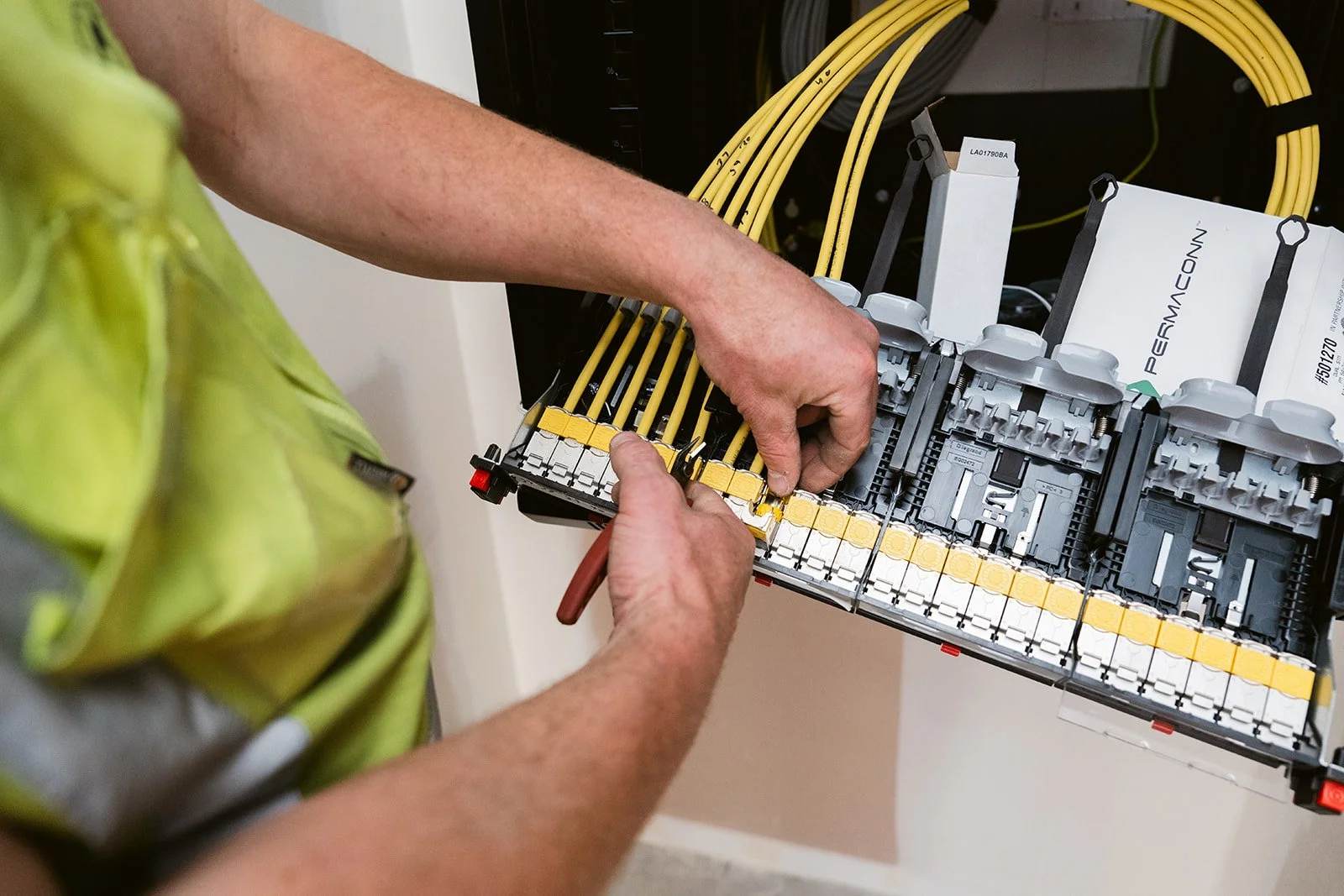
Network Rooms, Racks, Patch Panels, and Cable Management
A well-planned network room is the quiet centre of a dependable business connection. The difference is rarely the visible equipment alone; it is the discipline behind the network cabling infrastructure, from rack layout and patch-panel labelling to airflow, power access, and future capacity. Structured cabling gives every workstation, wireless access point, camera, and server a clear, traceable route back to the rack. Clean cable management protects performance as much as appearance, preventing strain, simplifying fault-finding, and making routine changes far less disruptive. For growing offices, retail sites, and multi-room premises, a properly organised installation keeps essential equipment accessible and the cabling ready for what comes next.
Commercial Cabling for New Builds, Upgrades, Moves, and Repairs
Commercial cabling is the quiet infrastructure behind dependable daily operations, whether a business is opening a new site, renovating occupied space, relocating teams, or correcting a persistent connection issue. Our cabling installation work begins with how the building will actually be used: workstation density, wireless coverage, phones, security devices, audiovisual equipment, and room for future growth. From there, we develop a clear project plan that accounts for pathways, labeling, testing, and access with minimal disruption to staff and tenants. We install and repair data cabling with the same attention to the details that determine long-term performance: clean routing, appropriate cable selection, organized racks, and documented connections. The result is reliable support for the systems your business depends on now and the changes ahead.
Commercial Cabling Essential
- Assess workstations, wireless access points, phones, security, audiovisual systems, and anticipated growth before planning installation.
- Map cable pathways and building access requirements to keep new construction, renovations, and moves organized.
- Select appropriate data cabling for performance needs, device demands, environmental conditions, and future expansion.
- Route cables cleanly through approved pathways to protect connections and simplify future maintenance.
- Organize racks, patch panels, and equipment rooms for easier troubleshooting and dependable daily operation.
- Label and document every connection clearly, giving teams accurate records for repairs, changes, and additions.
- Test installed or repaired cabling thoroughly to verify reliable performance before systems go live.
Start With a Site Survey and Cabling Assessment
A thorough site survey shows how each area is used, where capacity is falling short, and what can be retained. An experienced cabling contractor can then prepare a clear, practical quote rather than rely on assumptions.
Growth does not always require a complete replacement. New workstations, wireless access points, cameras, and cloud-dependent applications may be served by extending existing data cabling if its condition and category support current demands. Where older network cabling is congested, poorly labelled, or limited to lower speeds, recabling can reduce faults and simplify future changes. Fiber optic links are often the stronger choice between floors, buildings, or high-traffic equipment rooms, where distance, bandwidth, and electrical interference matter. The right fiber and copper solutions should reflect how the premises will operate over the next several years, not simply today’s immediate requirement.
Network Growth Decision Checklist
- Extend existing cabling when tested links remain reliable and support required speeds, devices, and power needs.
- Recable congested, damaged, poorly labelled, or low-category runs to reduce faults and simplify future alterations.
- Choose fiber between floors or buildings where copper distance limits, bandwidth demands, or interference create constraints.
- Use fiber for high-traffic equipment rooms supporting servers, storage, cloud applications, and multiple uplinks.
- Assess new workstations, access points, cameras, and connected devices before deciding whether capacity remains available.
- Plan cable pathways, cabinet space, labelling, and spare capacity for expected growth over several years.
Working Around Active Business Operations
Installing or upgrading commercial cabling in an occupied building calls for more than technical skill; it requires respect for the way the site operates. The best approach begins with a clear understanding of trading hours, access routes, sensitive work areas, and the services that cannot be interrupted. In a busy office, retail space, medical practice, or warehouse, cable pathways and equipment locations should be planned around staff, customers, stock, and safety requirements, not the other way around. Experienced installers coordinate deliveries, isolate work zones, manage dust and noise, and schedule disruptive tasks outside peak periods where possible. Just as importantly, they provide practical support throughout the project, keeping managers informed and leaving each area clean, secure, and ready for normal business to resume.
Data Cabling for Torrance Commercial Environments
Reliable data cabling is the quiet infrastructure behind productive Torrance workplaces. From professional offices and medical suites to retail spaces, warehouses, and multi-tenant properties, a well-planned low voltage system keeps networks organized, accessible, and ready for growth. The right design accounts for today’s workstations, wireless access points, phones, cameras, and specialized equipment without leaving a ceiling full of improvised runs. It also supports security systems that depend on dependable connections, including surveillance cameras, access control, and monitored entry points. For commercial environments, the priority is not simply getting a signal from one room to another; it is creating a documented, tested cabling foundation that performs consistently, looks professional, and makes future changes far less disruptive.
Serving Torrance and the Greater Los Angeles Area
From Torrance to communities throughout Angeles County, our team delivers structured cabling built for demanding commercial environments. We understand the practical differences between a South Bay office retrofit, a warehouse network expansion, and a multi-tenant property upgrade, and plan each installation around access, uptime, safety, and future growth. Our service area extends across Los Angeles, including San Pedro and surrounding business corridors, with project support available throughout Southern California. Clients seeking data cabling Orange County California can expect the same disciplined project management, clean workmanship, and responsive local coordination. As California’s premier commercial network cabling contractor, we bring a regional perspective to every area we serve while maintaining the careful, on-site attention that complex infrastructure work requires.
Data Cabling Installation FAQ
Data Cabling Installation FAQs